

On behalf of all the SARAG staff team and
our Trustees we would like to wish all our supporters, service users and their families a peaceful, happy Christmas and New Year
A Message from Nevyn Stevenson, Head of Service and Charity Development
As we approach the end of 2025, I’m incredibly proud to share what has truly been a record-breaking year for our charity. Together, we’ve achieved an astounding £7.8 million in benefits and compensation for our beneficiaries — the highest total in our charity’s history. This life-changing support continues to make a real difference for individuals and families affected by asbestos-related conditions across our region.
This year has also seen another remarkable milestone as our income has reached over £300,000 – another record for the charity. Every pound raised helps us expand and strengthen our services, and we are so grateful to everyone who has donated, taken on a challenge, or supported an event. You are the heart of what we do.
Our support groups and bereavement services have continued to grow, reaching and supporting more people than ever before. In our 2024/25 year, over 1,000 individuals received some form of emotional support — a powerful reminder of the need for compassionate, specialist care in the face of such difficult diagnoses.
Christmas is a time for reflection and gratitude, and I want to take this opportunity to say a heartfelt thank you — to our beneficiaries, fundraisers, donors, volunteers, and everyone who has supported us. Your commitment keeps us moving forward.
I also want to recognise the phenomenal work of our staff team, whose dedication and compassion are at the core of everything we achieve. Our Benefits Team — Ruth Davies, Jane Aitchison, Jason Shaw, and Caroline Holmes — have worked tirelessly to secure financial justice for those we support. Our Support Team — Deb Williams and Michaela Morris — have provided strength and empathy to those facing some of life’s hardest moments. Our Administrator, Ying Xuan Chian, is the first point of contact to our charity, and our Fundraising and Finance Officer, Penny Partlow, has been instrumental in delivering our most successful fundraising year yet.
It’s an honour to lead this incredible team into 2026.
Thank you once again for being part of our journey.
Wishing you all a peaceful Christmas and a hopeful New Year.
Warm regards,
Nevyn Stevenson
Head of Service and Charity Development
Staffing News
Michaela & Ruth turn 60!
Two amazing people (who we are very fortunate to have as members of our team) turned 60 this quarter. The team gathered to wish Michaela and Ruth a Happy Birthday in a small get together at our office. Cakes and balloons abounded to celebrate! All our good wishes for health and happiness Ruth and Michaela, and for many many more happy returns.
Don’t forget the SARAG Christmas Lunch on Monday 8th December at Holiday Inn Rotherham.
It’s FREE so contact us now to reserve your place or for more details:
enquiries@dreamy-cori.217-154-35-86.plesk.page or tel 01709 360672
SARAG Calendar 2026
Very limited stocks remain of our 2026 SARAG calendar. Beautifully produced by Lisa Staniforth and featuring incredible pictures of British birds, these make perfect gifts for family and friends. Calendars may be available to buy at our Christmas lunch if any are left, however don’t miss your chance to reserve one now as the remaining stock will not last long. These really are not to be missed!
Contact penny@dreamy-cori.217-154-35-86.plesk.page, tel 01709 360372 or click to buy online: https://dreamy-cori.217-154-35-86.plesk.page/product/2026-calendar/
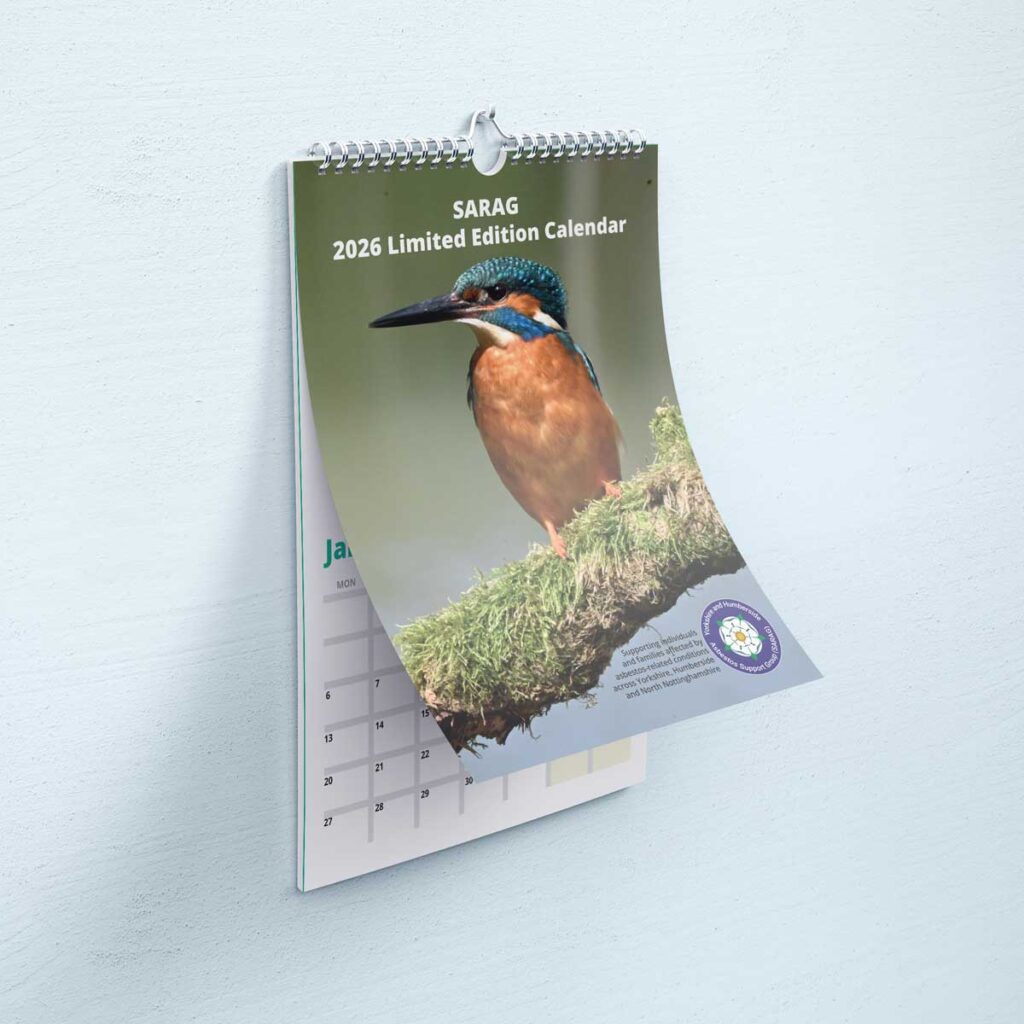
Limited Edition 2026 Calendar
A4 Wall Calendar
2025 Summary of Grants, Fundraising and Donations by Penny Partlow
During the last year, we wish to acknowledge the incredible and repeated support we have received from The Alex Ferry Foundation who have again contributed significantly towards the costs of our social groups. National Lottery Community Fund are also in the second of three years funding to support our Bereavement project, the Brelms Trust have awarded us £18,000 over three years and finally B & C E Charitable Trust again agreed to cover the costs of a part-time benefit adviser for a second year. We thank you all for your ongoing and vital support.
We have also been successful in several smaller bids from other organisations this year including The Blakemore Foundation, North Yorkshire Council, Norman Collinson Charitable Trust and working with the South Yorkshire Community Fund, we were able to access the Sir George Earle Benevolent Fund.
National Lottery Awards for All provided a substantial grant of £20,000 over two years to fund more benefit adviser hours and generous people playing the Rotherham Community Lottery have raised around £1000 for us.
In June a group of volunteers took on the Yorkshire Three Peaks Challenge and raised over £2500 for SARAG and we were lucky to receive two years membership of Sheffield Chamber of Commerce and Industry which is allowing us to widen our reach and increase our profile. Individuals took part in Marathons, abseiled from a bridge, organised quizzes and walked across the country raising thousands of pounds combined. One supporter produced an incredible calendar for us this year which raised over £2,000 and sold like hot cakes!
We’ve most recently been successful in grant applications to The Peoples Postcode Lottery/The Postcode Neighbourhood Trust, Skipton Building Society and the YOR4Good Fund and received a donation from The Sheffield 1000 (see p 12).
We are also lucky that so many of our readers and those we have supported also continue to donate to help us help others. We sincerely thank you all.
For 2026, funding applications and fundraising projects are increasing steadily and if you have any fundraising ideas, or can support us in any way, please get in touch.
Donations can be made to us at anytime through Paypal where 100% of the donation reaches us with no fees deducted. Click here if you would like to support us this way: https://www.paypal.com/gb/fundraiser/charity/3157989 We also gratefully receive cheques to our office or donations online to support our fundraisers:
Social Media links(please follow us):
LinkedIn: Yorkshire and Humberside Asbestos Support Group (SARAG)
X: https://x.com/yorkshireSARAG
Facebook: https://www.facebook.com/YorkshireSARAG
Facebook (private bereavement group):
https://www.facebook.com/groups/saragbereavementsupport
SARAG In Loving Memory – please feel to leave a message or tribute about a lost loved one: https://dreamy-cori.217-154-35-86.plesk.page/activities/in-loving-memory/
IMPORTANT SCAM WARNING ABOUT WINTER FUEL PAYMENTS
We’ve been made aware of a number of scams happening recently and we want to urge you to be extra vigilant, especially if you receive text messages about winter fuel payments.
Winter Fuel Payments are made automatically, and the government will never ask for bank details by text. Anyone who receives a text message inviting them to apply for a payment should not engage with it and instead forward it to 7726.
Work and Pensions Secretary Pat McFadden said: If you get a text message about Winter Fuel Payments, it’s a scam. They will be made automatically so you do not need to apply. These despicable attempts by criminals to target people are on the rise. We are raising awareness to make it harder for fraudsters to succeed.
If you are not sure, ask DWP or ask us. NEVER give your bank details to a text asking for that information.
2026 Dates For Your Diary
Please see page 16-17 for more details
Bradford Social Group: 1st Tuesday of the month
Doncaster Social Group: 2nd Tuesday of the month
York Social Group: 3rd Monday of the month
Hull Social Group: 3rd Tuesday of the month
Sheffield Social Group: 4th Tuesday of the month
Online/Zoom peer support group:
Contact Michaela for dates
Bereavement Group Wakefield: 1st Tuesday of the month
Bereavement Group Sheffield: 4th Tuesday of the month
Bereavement Peer Support Zoom Meetings:
Contact Deb for dates
MESSY Zoom: 1-2.30pm, 16th Jan, 13th March, 15th May, 17th July, 18th Sept, 13th November
MESSY Leeds: 1-3pm, 13th Feb, 17th April, 12th June, 14th August, 16th October, 11th December
Christmas Lunch: Monday 8th December 2025
Rotherham Holiday Inn, S60 4NA
SKYDIVE!! Friday 1st May 2026. See page 22 for more details!
Fundraising News
Leigh Day Fundraising Walk
On Tuesday 15th July, Leigh Day’s Asbestos Teams from across the North gathered for a day of fundraising walks to support those affected by asbestos related diseases. Their teams visited hotspots around the UK where there has been a devastating legacy left by the impact of asbestos exposure.
Teams from Manchester and Chesterfield met in Leeds and set off along the Docks to Thwaites Watermill.They were joined by Michaela from the SARAG team and despite the blustery conditions the team managed an impressive 10km along the Trans Pennine Trail before jumping on the train back over to Manchester to continue their walk on the other side of the Pennines.
Louisa Saville, Partner, said “events like this help to raise awareness and show solidarity with all those impacted by the catastrophic effects of asbestos exposure, as well as honouring and highlighting the important work of support groups across the UK”
Thank you so much Leigh Day Team!
Nev’s 10k run (yes, another one!)
Nevyn’s third run in 2 years to support our charity took place in Sheffield on Sunday 28th September. Single-handedly through Nev’s efforts, this third run has now increased Nev’s personal fundraising total to over £2000! All the money raised will go towards supporting more people get access to the expert advice they need to help them following the difficult diagnosis of an asbestos-related condition.
Thanks for all you do for our cause Nev, SARAG is lucky to have you!
SARAG Abseil
On the 12th of September a team of volunteers including Penny and Michaela from SARAG, plus Nicola Handley, Vicky Lill and Kerry Ford from Irwin Mitchell Solicitors, took part in a hair-raising 120 ft abseil from a bridge in Millers Dale on the Monsal Trail. Whilst initially fears ran high, the intrepid bunch soon conquered their fears and managed to climb up and over the barrier, then descended hand under hand until reaching the river bed below! Luckily no one got wet, everyone became experts very quickly and the team raised well over £2000 for their efforts. Absolutely brilliant effort and SARAG thanks you all!
Rachel’s Charity Garden Party Fundraiser
Rachel Oakes, widow of the late Rick Oakes, recently opened her home and garden to raise money for four charities: SARAG, Mesothelioma UK, St. Leonards Hospice and Marie Curie. Rachel organised the spectacular event to honour the memory of her beloved Rick, who was diagnosed with mesothelioma after being exposed to asbestos as an apprentice joiner over 50 years earlier. Despite losing his battle with the disease last year, Rick faced every step of the disease with strength and positivity and Rachel wanted to thank the organisations that had helped them through such a difficult time.
We are very grateful for this support Rachel and the £4000 we received will go towards helping more people access the benefits and compensations they are entitled to. Thank you so much Rachel!
Other Funding News
The Sheffield 1000 is a charity where people donate just £1 per week to help worthy causes in the city. Donors then nominate the organisations the charity supports and we are massively fortunate to have received £1000 from them this month. The money will go towards the running costs of our Sheffield Social and Bereavement Groups held in Burton Street. We are very grateful for this support Sheffield 1000 and if readers would like to find out more, or get involved with the project, please click here: https://thesheffield1000.org/
We are also very fortunate this quarter to have received two separate contributions towards our benefit adviser salaries. Skipton Building Society awarded us a £2,500 and People’s Postcode Lottery with Postcode Neighbourhood Trust awarded us £25,000. These amounts will ensure we can continue to apply for all the benefits our service users are entitled to.
The support side of our charity work has also not been overlooked for funding this quarter either. We’ve been successful in an application to the YOR4GOOD fund. YORhub Contractors make commitments to deliver positive social value outcomes benefiting local communities within their area and all applications for a grant must be sponsored by a YORhub Framework Contractor. We are so grateful to Robertson Construction Yorkshire & East Midlands, who sponsored and supported our application. We were incredibly lucky to be awarded a substantial grant of £20,000 too, which is double the usual amount. Supplying funding towards the support work in our organisation will help YOR4Good contribute to their aim of creating healthier communities and helping vulnerable people.
This funding received makes a massive difference to us, and those we support, so we are saying a huge “THANK YOU!” to Sheffield 1000, Skipton, People’s Postcode Lottery and YOR4Good for your incredible support.
Fatigue by Michaela Morris,
Support and Activity Worker and Occupational Therapist
Many people living with an asbestos related disease often feel fatigued which can be thought of as simply part of the condition and not reported or addressed thoroughly. I really hope that understanding fatigue and the tips in this article will be helpful for you. Some things won’t apply to you but I hope you will find that even small changes can help you.
What is fatigue?
It’s so much more than feeling tired and affects us in a variety of ways. Tiredness is different and can been relieved by restorative sleep. People describe fatigue in ways such as “I can’t concentrate or focus”, “I feel I have to sleep”, “it makes me want to do nothing, it’s not a good thing, it just makes me feel low and frustrated”, “It’s hard to get going and everything is a real effort.” Fatigue can be overwhelming and it is not relieved by sleep.
Causes of fatigue.
Many things cause fatigue: disease processes, the effects of treatment, poor absorption, other conditions such as anaemia, or being out of condition.
The effects of fatigue.
It’s not just physical; fatigue can make us feel bogged down, frustrated with ourselves and misunderstood. Also effects our thinking, struggling with the crossword, hard to keep hold of information, follow conversations or TV. It can be harder to make decisions and can make us feel low. It can be very up and down, with good days and bad days. When fatigued it is easy, and understandable, to start limiting your activities, reducing social interaction or not engage in hobbies/ outings etc.
This fatigue cycle is helpful for seeing the impact. Doing less makes us more tired ironically and is not good for our well being, overdoing it makes it worse too. So balance is the key !! Trying to avoid boom and bust!
The 5 P’s of managing fatigue:
to help with balance and good activity, helping us to feel less overwhelmed by fatigue and more in control.
Posture – it’s easy to slump when sitting or walking.
Try walking poles or a walking stick (at correct heights!) to help with good upper body posture and stride. Think about your sleep position. Holding ourselves in good posture is better for the lungs too.
Priorities – where is my energy going and what is important? If time with grandchildren is important – don’t do loads of chores before they visit and maybe, you can skip other things that don’t give you joy or energy. Delegate where you can, we know it’s hard to ask for help and do things differently but focusing on what is important can help you adjust and let go.
Pacing – listen to your body. Does the task need to be done in one go? Usually not, so pace yourself, don’t wait till you are really tired to stop. That way you don’t pay for it the next day.
Planning – look at the week ahead – is there a balance? Can you have a quieter day before an event/travel? Are you trying to do too much or the reverse, doing too little? Get in touch with a friend, join a group, restart a hobby with adjustments.
Preserving energy – a big one. We are creatures of habit and it can be hard to do things at a different time or in a different way. Do I have to have a shower everyday? When is my “better” time of day? Do I try and cram in all the chores rather than think the sun is shining I will go for a short walk/ see a friend instead. Can things be made easier? Stair rail, easier foods, getting a cleaner/ gardener, a seat in the shower. When we are fatigued we are at a higher risk of falls so being safe is good.
Diet. Eating a healthy balanced diet is important – enough to keep up your energy levels. Focus on energy giving foods: carbohydrates, fruit, veg and plenty of fluids. Slow-release energy food such as porridge with fruit on, is a great way to start the day for example. A light snack before bed may make it easier in the morning. Treats are okay !! Ask for referral to a dietitian if you have ongoing problems.
Exercise. Research shows that light to moderate physical activity every day helps people with fatigue. That can be hard when you have little energy but like a kinetic watch, we need movement to work! Start small and build up gradually, being with others can help. Don’t overdo it and even if just a walk around your room during the ad breaks or while the kettle is boiling is good. Make the activity meaningful not just walking for the sake of it, to your favourite place, with music, or to post a letter. Drink plenty of water whenever you exercise to prevent dehydration and work at your level of comfort and pace – it’s not a race. Exercise clearly is also good for appetite and sleep.
Improving sleep. Fatigue can effect the quality of our sleep and getting too much sleep is not helpful. Go to bed and get up at the same time each day. Avoid TV and phones in your bedroom. Try not to worry about getting less sleep, or having a bad night, as this sets up the likelihood of a poor night’s sleep. We need less sleep as we get older but working on the quality is important. The temperature in your bedroom, a good sleep position and dealing with stress and worry during the day are helpful. If you are just lying there, go and do something away from your bedroom. Caffeine and alcohol effect sleep so reduce it if possible, and have none after 4pm, as it stays in your system. Remember decaffeinated is only reduced caffeine not caffeine free! Try having a warm milky drink (sorry not chocolate as it has caffeine in!) or a warm bath before bed. Sleep is a big topic so maybe more on that another time! If you’re struggling to sleep at night, try to avoid napping in the day or at least limit to no more than 30 minutes.
Managing worry and stress. Worry and stress take a lot of energy so managing them can really help with fatigue, sleep and general wellbeing, a whole topic for future pages. When you recognise you are in that worry cycle and things are going round and round in your head, like a hamster in a wheel, a great question to ask yourself “Is this helpful?” if yes, it’s making me get up and do the thing I need to do then fine, but if it’s not helpful, not changing anything and just pulling me down, then step back and go and do something else – music, walk, talk or whatever is helpful for you. The first step is to recognise what you are worrying about and if out of your control, such as waiting for scan results, put it to one side. It‘s not helpful and making a tough day tougher. Lots of self-care and not being harsh on yourself day by day, focus energy on what is important and enhances and nourishes you.
The Jug Theory! This is a great way of recognising what things that give us joy, also give us energy while so many other things drain us. So have a think of how you are spending your time and energy.
Carer support
Living with someone struggling with illness and fatigue is tiring, giving gentle encouragement and enabling them to do what they enjoy. Much of the above are helpful for all of us. Making sure you get breaks, eating well, sleeping well and exercising important for you too. It can be hard to admit that maybe its time to get some help or simply to adjust to doing things differently.
Further resources and support are available. Do get in touch:
michaela@dreamy-cori.217-154-35-86.plesk.page.
Maggie who can sleep anywhere and for way too long!
Finding Our Feet
the newsletter from the Bereavement & Family Support Service
By Deb Williams:
Welcome to the winter edition of SARAG’s newsletter and the submission from our Bereavement and Family Support Service.
I hope you find this section supportive, informative and compassionate. We also welcome and encourage submissions from both our bereaved community and those facing anticipated grief. This is your space to share and to support each other on this journey.
Winter can be a difficult time for many as the nights have drawn in and daylight is so short. But when we are bereaved or are anticipating a bereavement the long dark nights, and short days can make it harder for us to motivate ourselves to do much and can often negatively impact our grieving minds.
Winter can feel cold and isolating, so too can grief. Grief is a time of shock, numbness, and disbelief, even anger and overwhelm. It is important to allow yourself to feel these emotions without judgment. Just as the earth needs the rest and stillness of winter, and to go into itself, to prepare for new growth, we too need this time to be still, to look inside, and to process our feeling of loss. Winter is a time of reflection. As you look out onto the empty landscapes, remember the memories and love that remains within you. These are the seeds of hope that will carry you through to the next season. And remind yourself that the bare trees of winter eventually give way to the new growth of spring, symbolizing hope and renewal. This cyclical pattern can provide comfort and perspective to those in the throes of grief
Nature can help us feel connected to something much larger than ourselves. This sense of connection can be comforting during times of grief, reminding us that we are part of a vast, interconnected web of life, and we are not alone.
Here’s a little nature exercise for you to try:
Using your senses
Go out and visit a favourite woodland or forest. Dress appropriately so that you are warm and dry.
Stroll into a quiet part, an area that you are already familiar with, so that you feel safe, relaxed and at ease.
Look around and notice the colours. Feel the invitation to be drawn to touch whatever captures your interest and notice its texture, temperature and moistness.
Inhale the scent of the air around you or perhaps some nearby moss or earth from beneath your feet. Inhale deeply – you will probably be very pleasantly surprised as you breathe in the earthy aromas.
You may notice the fluffy or lace-like lichen growing on the branches and trunks of trees, or a rain drop hanging down from a pine needle.
Once you start noticing the intricacies of the landscapes you walk, you don’t stop noticing. The slower you walk and the quieter you are. The quieter you are, the more the natural world will accept you and the more beauty you will be shown.
As you walk through the landscape, take note of what colours, energies, scents, textures, sounds and qualities you sense. What feelings do these evoke within you? How does your body feel? How does your heart feel? What is your breathing like?
Nature helps to provide us with a model for grieving, for resilience and for hope. There is a season for everything, and nature opens our eyes to that.
Poet’s Corner
FIRSTS
People talk about the last times a lot.
The last time you said you loved them,
held their hand,
heard them laugh.
But what about the firsts?
The first time your birthday comes around and there is no card from them.
Or the first time you gather as a group, and they are missing.
The first time you wake up and remember they are no longer here.
The firsts will hurt in a way the lasts did not.
They will sting, burn, break you.
Because firsts signify the start.
A new beginning.
The beginning of the rest of your life
without them there beside you,
with a missing birthday card
a missing hand to hold.
The beginning of the rest of your life missing them.
But remember…
We only experience something for the last time once.
And we only experience something for the first time once.
So, I know you will miss them for the rest of your life.
But it won’t always hurt or sting or break you like this.
© Becky Hemsley
Well-being, breathing exercises.
Each quarter, I will aim to bring you an exercise that could help with how grief/bereavement might be negatively affecting your breathing, and thus your overall well-being.
Being bereaved and experiencing grief is a very stressful time. Being stressed can affect our breathing. Our everyday breathing patterns are often overlooked in the management of stress, anxiety, and panic. However, the way we breathe everyday influences how we feel and how much stress we experience. It also dictates how we breathe and how our bodies respond during high-stress situations. This breath-mind connection is not new-age woo woo. It has long been accepted by the scientific community that how we breathe affects which branch of the Autonomic Nervous System (ANS) – the ‘fight or flight’ Sympathetic branch responsible for the stress response, or the Parasympathetic ‘rest and digest’ responsible for relaxation, is activated. Our breath is a fundamental ‘state changer’ and by manipulating our breath and changing how we breathe, we can alter how we feel on both a physiological basis and a psychological basis.
Where possible breathe only through the nose. Good functional, everyday breathing incorporates breathing through the nose during rest, activity and sleep. Breathing through the nose takes practise and consistency. This will initially take conscious practise. Nasal breathing triggers the relaxation response and helps to prevent over breathing which is a major fueller of anxiety and panic. Nasal breathing during wakefulness slows and draws the air into the lower parts of the lungs. This may help to maintain the strength and function of the breathing muscles and reduce the feeling of breathlessness.
When we are feeling stressed:
• Breathing becomes faster • Sighing becomes more frequent • More air is breathed with each breath • Breathing tends to be primarily limited to the upper chest • We tend to breathe through the mouth • There is a sensation of air hunger or suffocation.
When we are feeling relaxed:
• Slow breathing • More regular breathing (less frequent sighing and yawning) • Lighter breathing • Breathing low into the diaphragm • Breathing in and out through the nose • Effortless breathing with no feeling or sensation of air hunger
When breathing becomes faster, harder, shallower and from the upper chest it feeds into feeling breathless. The Breathe Light (Biochemical Dimension of breathing) Exercise, focuses on breathing less air to reduce the body’s sensitivity to carbon buildup dioxide (carbon dioxide is the main driver to breath, not a lack of oxygen) and helps (with practise) to normalize breathing volume and lessens the urge to breathe.
Exercise: Feather Breathing
(Traditional Buteyko Exercise)
Posture: Sit comfortably with your feet flat on the floor. Imagine there is a piece of string pulling you upwards from the top of the back of your head towards the ceiling. Lengthen your spine. Widen the space between your ribs to create a tall, open posture.
Awareness: Place your forefinger underneath your nose so you can monitor the airflow from your nostrils. This will provide you with immediate feedback about your breathing. Bring your attention to the airflow on your finger. Can you feel the warm air as it flows onto your finger? There is no need to focus on the movement of your chest or belly. Instead, concentrate solely on the airflow against your finger. Really immerse yourself in the sensation of the warm air as it leaves your nose and brushes against your finger.
Slow down your breathing: As you feel the warm air on your finger, gently slow down your breathing. Take a soft breath in through your nose and allow a gentle, prolonged exhalation. Breathe so softly that you can hardly feel any air blowing onto your finger. Imagine your finger is a feather, and your breathing is so light that the feather doesn’t even flutter. Gradually slow the speed of the air leaving your nostrils. The goal is to slow your breathing to the point where you feel almost no air on your finger. There is no need to hold your breath or intentionally restrict your breathing. It’s important not to interfere with your breathing muscles. Instead, allow your breathing to soften by concentrating on the warm air as it flows onto your finger. The warmer the air you feel on your finger, the harder you are breathing. Can you quieten and soften your breathing to the extent that you feel hardly any air on your finger?
Tolerable air hunger: The volume of air you are breathing during this exercise should be less than what it was before you began. You are performing the exercise correctly if you experience a tolerable need for air, which is a subtle urge to inhale more air. The sensation of needing air should feel tolerable during both inhalation and exhalation. As you reduce the volume of air you breathe, it’s normal to experience a slight tension in your diaphragm. However, if you begin to notice involuntary contractions of the diaphragm, this indicates that your need for air has become too much. When this occurs, take a break from the exercise for 30 seconds or so to allow your breathing to normalize before returning to it.
Repetitions: With consistent practice (daily), the goal is to maintain a tolerable sense of air hunger for 4-5 minutes.
NB: Please check with your GP if you are new to breathing exercises and you are concerned about your health.
*(Adapted from the Buteyko Clinic International manual)
Meals For One
Budget Arrabiata Pasta
Preparation time less than 30 mins. Cooking time 10 to 30 mins. Serves 1
A fast and spicy supper that’s ready in less than 20 minutes. Feel free to use any pasta shapes you like and chopped fresh chilli instead of dried flakes if you prefer. The cheddar can be swapped for Parmesan or any cheese you have handy – or left out altogether. This recipe is part of a Budget meal plan for one. In September 2023 this recipe was costed at an average of £1.16 when checking prices at five UK supermarkets. This recipe is designed to be made in conjunction with a low-cost store-cupboard.
Ingredients
100g/3½oz dried pasta, such as penne
3 tbsp oil, ideally olive oil
4 garlic cloves, very thinly sliced
¼–½ tsp dried chilli flakes, to taste
400g tin chopped tomatoes
salt and ground black pepper
25g/1oz cheddar, finely grated, to serve
Method
1. Half-fill a medium saucepan with water and cover with a lid. Place over a high heat and bring to the boil. Add the pasta and stir. Cook uncovered for 10–12 minutes, or until the pasta is tender but retains just a little ‘bite’. Stir occasionally as the pasta cooks, so it doesn’t stick.
2. Meanwhile, heat the oil in a frying pan. Add the garlic and cook over a very low heat for 2 minutes, or until the garlic is softened but not browned, stirring regularly. Add the chilli flakes and cook for a few seconds more, stirring constantly.
3. Remove the pan from the heat and gently stir the tomatoes into the garlic-infused oil. Place the pan over a medium–high heat and bring to a simmer. Cook for 5–7 minutes, stirring regularly until the sauce is fairly thick and glossy. Season with a little salt and lots of pepper.
4. Drain the pasta in a colander or sieve, then add to the tomato sauce. Toss together and sprinkle with the cheese to serve.
Recipe tips
When cooking the garlic, it’s important not to let it burn or it will make the sauce taste bitter. Bring out the sweetness of cheap tinned tomatoes by adding half a teaspoon of sugar to the sauce. Any leftovers can be kept in the fridge for a couple of days, or frozen for a month. Thaw in the fridge overnight then reheat in the microwave or in a pan on the hob with an extra splash of water.
By Justine Pattison (from BBC recipes)
Dates For Your Diary
See below for our face to face bereavement groups dates and for our peer support zoom meetings, just contact Deb for joining details.
We also have a private Facebook page should you wish to join us. You can find us at https://www.facebook.com/groups/saragbereavementsupport.
St Swithun’s Community Centre,
Arncliffe Rd,
Wakefield
WF1 4RR
Time: 12-2pm
6th Jan
3rd Feb
3rd Mar
7th April
5th May
2nd June
7th July
4th Aug
1st Sept
6th Oct
3rd Nov
1st Dec
The Burton Pub Room (upstairs),
The Burton St Foundation,
Sheffield
S6 2HH
Time: 12-2pm
27th Jan
24th Feb
24th Mar
28th April
26th May
23rd June
28th July
25th Aug
22nd Sept
27th Oct
24th Nov
22nd Dec
I hope you have enjoyed our submission in SARAG’s newsletter. Please feel free to contact me directly either by emailing me at deb@dreamy-cori.217-154-35-86.plesk.page, or contacting by phone or text messaging on 077141724126 should you wish to contribute anything to the next newsletter in 2026. It might be that you would like to write your own poem, share a story or have some ideas that you think will help our Bereavement & Family Support Service, or could enhance our content in the newsletter.
Take care during these winter months. You know where I am. Warmest of wishes, deb.

This is the big one! Will you join us at 15,000 ft?
On Friday 1st May 2026 we will be taking to the sky above Lincoln to raise money for our charity. A mix of staff and volunteers are taking part and we have spaces available if you, or anyone you know, would like to join us.
All jumps are in tandem, attached to a fully qualified and experienced skydive expert, all equipment is provided and there will definitely be a celebration afterwards! Please get in touch for more detail and reserve your space now!
Contact penny@dreamy-cori.217-154-35-86.plesk.page or call 01709 360372.
From all of us at SARAG, to all of you, we wish you a very
HAPPY NEW YEAR
What would you like to see in next years newsletters?
As we approach the end of 2025, we hope you have enjoyed reading our newsletters as much as we enjoy putting the content together. We try to make it a mix of information sharing, fundraising news and topics that may help with health and wellbeing.
There is always room for improvement though so what would you like to see next year? More articles about our work? Case studies or stories about the people we have helped? More games or quizzes? Fundraising events or activities that you could take part in?
We welcome all suggestions for content to make our newsletter bigger and better for 2026. Please send any comments, ideas or suggestions to penny@dreamy-cori.217-154-35-86.plesk.page
We’d like to take this opportunity to wish you a
Merry Christmas and a Happy New Year from all at SARAG!